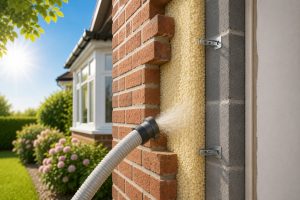
Wall insulation Leeds homeowners choose depends heavily on when their house was built. Leeds has a real mix of housing. Victorian back to back terraces have solid walls. Interwar semis usually have a cavity. Consequently, the right type of wall insulation is not the same for every street in the city. This guide sets out what Leeds homeowners need to know before booking a survey.
Solid wall or cavity wall, how to tell in a Leeds home
Most Leeds properties built after the 1920s have a cavity wall. A cavity wall is two layers of brick with a gap in between. Therefore, cavity wall insulation is usually the cheaper and quicker option for these homes. In contrast, many inner city Leeds terraces built before 1920 have solid walls with no gap at all. This is especially common around Holbeck, Burley and Hyde Park.
For example, a simple way to check is to measure the thickness of an external wall at a window or door. A solid wall is usually around nine inches thick. A cavity wall is closer to eleven inches, including the gap. If you are unsure, a wall insulation Leeds surveyor can confirm the construction type. This usually happens during a free assessment before any system is recommended.
What does wall insulation cost in Leeds
Cavity wall insulation is the more affordable route where it applies. Costs for a typical three bedroom semi tend to sit toward the lower end of the national range. This is because the work is quick and does not need scaffolding in most cases. However, homes with solid walls face a bigger decision. Insulating a solid wall means choosing between an internal or an external system.
Wall insulation Leeds installers quote for these two solid wall options very differently, since external work involves scaffolding and render, while internal work involves plasterboard and finishing inside each room. As a result, it pays to get quotes for both before deciding which route suits your budget and your plans for the property.
For a full breakdown of costs across every wall type, our guide to wall insulation cost UK wide covers cavity, internal and external options side by side.
Choosing between cavity, internal and external wall insulation
Homeowners in older parts of Leeds often ask which system suits a solid wall property best. External wall insulation adds a layer to the outside of the building. It does not reduce room sizes. Internal wall insulation, on the other hand, is fitted from inside. It tends to cost less upfront, though it does take a little space from each room.
Because Leeds includes both housing types within a short distance of each other, sometimes on the same street, it is worth reading a direct comparison before deciding. Our guide to cavity wall insulation versus solid wall insulation explains which one your home actually needs.
For example, a stone fronted terrace in Chapel Allerton might sit only a few streets from a 1930s semi with a cavity wall. Consequently, two neighbours on the same road can end up needing completely different systems, at very different price points, based purely on when their homes were built.
Grants and funding for wall insulation in Leeds
Most funding support for wall insulation Leeds households can access comes through the Warm Homes: Local Grant. This is a government funded scheme delivered by local authorities across England. It can cover cavity, internal or external wall insulation, depending on the survey outcome. The scheme is aimed mainly at low income households, or those living in a qualifying postcode area.
Eligibility usually depends on income, certain benefits, or your home having an EPC rating of D or below. Therefore, it is worth checking your EPC before applying, since this affects what support is on offer.
If your Leeds property has solid brick walls and you are considering the external route instead, our sister site has a dedicated local guide to external wall insulation grants. It explains eligibility for that system specifically.
Common wall insulation problems in Leeds homes
Older cavity wall insulation installed decades ago can sometimes cause damp. This is particularly true on exposed elevations facing prevailing weather. As a result, some Leeds homeowners are now having older cavity fill removed and replaced with a more modern system. In contrast, others are switching to external wall insulation instead. If your home already has cavity insulation and you are seeing damp patches, it is worth getting a proper survey. Do not assume the insulation itself is always the cause.
Furthermore, solid wall properties that have been internally insulated without enough ventilation can also develop condensation over time. As a result, a good installer will always assess ventilation as part of the specification. This matters just as much as the insulation board itself.
Finding a trusted installer for wall insulation in Leeds
However you approach it, choose an installer registered with a recognised competent person scheme. Furthermore, ask for references from recent jobs on similar properties nearby. In addition, always get more than one quote. Prices and specifications can vary considerably between companies for what looks like the same job on paper.
A reputable wall insulation Leeds installer will survey your home in person before quoting. Even so, be cautious of anyone offering a price without seeing the property first. Wall construction varies so much across different parts of Leeds that a phone estimate is rarely accurate.
When to book wall insulation work in Leeds
Many installers in Leeds get booked up quickly once autumn arrives, as homeowners rush to insulate before the cold weather sets in. Therefore, booking a survey during spring or summer often means a shorter wait and more availability for your preferred installation dates. In addition, external wall insulation work is easier to carry out in drier weather, since render needs time to cure properly before rain arrives.
However, if your only concern is cavity wall insulation, the season matters less, because the work is quick and does not depend on external conditions in the same way. Even so, booking early in the year still tends to secure a better price, since demand rises sharply once the weather turns.
How long does wall insulation take to install in Leeds
Cavity wall insulation is usually the fastest option, and a typical semi can be completed within a single day. However, internal wall insulation takes longer, because each room needs plastering and finishing after the insulation boards go up. Consequently, homeowners should plan for a few days of disruption per room, plus time for the finish to dry before redecorating.
External wall insulation takes the longest of the three systems. For example, a typical Leeds terrace can take one to two weeks from scaffolding going up to the final render coat curing. Furthermore, the exact timeline depends on the size of the property and the weather during installation, so it is worth asking your installer for a realistic schedule rather than a best case estimate.
 Get a free quote for wall insulation in Leeds
Ready to find out what wall insulation could cost for your home? Get a free, no obligation quote from a local accredited installer. A proper survey will confirm your wall type. It will also confirm the right system for your property, and the funding you may be able to claim.