Drylining insulation involves fixing insulated plasterboard, or a timber or metal stud lining, to the inside face of an existing wall. It is one of the most common ways to add internal wall insulation to a UK home. This applies particularly where external work is not possible or not wanted. In addition, it suits homeowners who want to treat one room at a time rather than commit to a whole house project. This guide explains how drylining insulation works, what it costs, and the practical details that determine whether a job performs well for decades or causes problems within a few years.
How Drylining Insulation Works
There are two main approaches to drylining insulation. The first, insulated plasterboard, combines a rigid insulation board with a plasterboard face in a single laminated sheet. Installers fix this directly to the wall using dabs of adhesive. They then skim and decorate over the top.
The second approach, a studwork lining, involves building a timber or metal frame slightly away from the existing wall. Installers fill the void with insulation batts, then fix plasterboard to the frame. Therefore, this method allows for thicker insulation than laminated boards typically achieve. However, it takes up more room depth.
Both approaches suit similar situations. They work well where external wall insulation is not possible. This applies due to conservation restrictions, a lack of budget, or a shared wall with a neighbour. In addition, they suit anyone renovating a single room rather than an entire property, since drylining insulation can be applied room by room.
Why Vapour Control Matters So Much
Drylining insulation changes how a wall behaves thermally, and this has a knock on effect on moisture. Adding an insulation layer to the inside of a wall shifts the dew point closer to the room side of the original wall. The dew point is the temperature at which moisture in the air condenses into liquid. Therefore, understanding this shift matters before choosing a system, not after installation.
Without a vapour control layer, warm moist air from inside the room can pass through the plasterboard and insulation. It then condenses against the colder original wall behind it. Over time, this leads to damp, mould, and in solid walled properties, potential damage to the masonry itself. As a result, a properly specified drylining insulation system always includes an appropriate vapour control layer. Installers position this on the warm side of the insulation.
This is one of the most common points where budget drylining jobs go wrong. Skipping the vapour control layer to save cost can create moisture problems. As a result, these problems often cost far more to fix later than the saving was worth.
Acoustic Performance Alongside Thermal Performance
Drylining insulation affects sound transmission as well as heat loss. This matters particularly on shared or party walls between terraced and semi detached properties. In addition, mineral wool based systems generally outperform rigid foam boards for acoustic performance. The fibrous structure absorbs sound energy more effectively than a solid foam layer.
If noise from a neighbouring property is a concern alongside thermal performance, raise this with your installer before specifying the system. A system chosen purely for U value on paper may not deliver the acoustic improvement you are actually hoping for. Therefore, mentioning noise specifically, rather than assuming any insulation upgrade will help equally, gets you a system suited to both goals.
What Drylining Insulation Costs
Costs vary depending on the approach chosen and the number of rooms treated. Insulated plasterboard typically costs between 30 and 50 pounds per square metre installed. In addition, this includes materials, labour, skimming, and making good. A studwork lining with mineral wool batts costs somewhat more. This typically falls between 40 and 65 pounds per square metre. Therefore, the additional framing work involved explains most of that price gap.
For a single average sized room, total costs including redecoration typically fall between 1,500 and 3,000 pounds. In addition, a whole property undergoing internal insulation on all external walls costs considerably more. This often falls between 6,000 and 12,000 pounds depending on property size.
Grants through ECO4 can reduce this cost for eligible households. In addition, the Warm Homes Local Grant offers a further route for households that do not qualify for ECO4 directly. Therefore, eligibility depends on household income, benefits received, and the property’s current EPC rating.
Practical Disruption to Expect
Drylining insulation involves genuine disruption to the rooms being treated. Skirting boards need removing and refitting further out from the original wall line. In addition, window reveals often need extending to meet the new wall face. Electrical sockets and switches on external walls need moving forward or rewiring.
Because of this, most homeowners plan drylining insulation room by room rather than attempting a whole house at once. This applies particularly if they are living in the property throughout the work. In addition, a phased approach spreads the cost over a longer period, which suits many household budgets better than a single large project. A single room typically takes three to five days from strip out to a finished, decorated wall.
When Drylining Insulation Is Not the Right Choice
Drylining insulation is not always the best option. For solid walled properties where external appearance does not need to be preserved, external wall insulation often makes more sense. This applies especially where minimising internal disruption matters more than cost.
Properties with existing damp problems need those issues resolved before drylining goes ahead. Therefore, insulating over an active damp problem traps moisture against the wall. As a result, it makes the underlying issue worse, not better.
How Long Drylining Insulation Lasts
A well specified drylining insulation system typically lasts as long as the plasterboard finish itself. This often means 25 years or more before redecoration needs attention. However, this assumes the vapour control layer stays intact and no moisture problems develop behind the lining.
Because the insulation sits hidden behind plasterboard, problems can go unnoticed for some time if they do occur. Therefore, watching for early warning signs helps catch issues before they become serious. This includes a musty smell, cold patches, or discolouration near skirting boards. In addition, an annual visual check of external elevations helps too. Look for cracks or damaged pointing that could let moisture reach the insulated wall from outside.
Questions Worth Asking Before You Book
Ask your installer to confirm which vapour control approach they plan to use, and where it sits within the build up. This detail matters more than the headline U value. A missing or poorly positioned vapour control layer causes most drylining failures.
In addition, ask whether the system has been assessed for interstitial condensation risk specifically for your wall type. Therefore, some solid walled properties need a different approach than standard cavity walled homes, since moisture moves through each construction type differently.
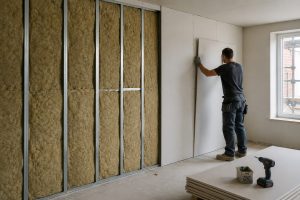 Getting the Right Drylining Insulation Specification
For a full comparison of internal and external approaches, our guide to internal wall insulation covers the decision in more depth. For a broader look at material options across all wall insulation types, our guide to wall insulation materials covers the full range available for UK homes.
The Energy Saving Trust’s solid wall insulation guide offers independent guidance on internal insulation for solid walled properties, worth reading before choosing a system.
If external work suits your property better, our sister site ecoinsulation.co.uk has a complete guide to external wall insulation systems covering that approach in full.
Drylining insulation can transform how a room feels, both thermally and acoustically, but only when specified correctly for the wall behind it. Therefore, getting the specification right matters more than choosing the cheapest quote. Contact us for a qualified installer today for an assessment. Get a specification that accounts for vapour control, acoustic performance, and your specific wall construction, not just a headline U value.