Cavity insulation remains one of the most cost effective energy efficiency measures available to UK homeowners, and in 2026 it is still possible to get it funded. The Great British Insulation Scheme closed in March 2026, but ECO4 continues to run until 31 December 2026 and cavity insulation is one of its core eligible measures. The Warm Homes Plan, the government’s £15 billion successor programme, also identifies cavity insulation as a foundational upgrade that properties need before other clean energy measures can work efficiently. For homes with unfilled cavities, this is the year to act.
Cavity insulation works by filling the gap between the inner and outer leaf of a cavity wall with an insulating material. That gap, typically between 50mm and 100mm wide, acts as a pathway for heat to escape the building. Once filled, the wall retains heat far more effectively. The thermal improvement is significant and the disruption is minimal. An installer drills small holes through the outer leaf of the wall, injects the insulating material under pressure, and fills and points the holes on completion. The whole process for a standard semi-detached house typically takes between half a day and a full day.
What Grants Are Available for Cavity Insulation Right Now
ECO4 is the most direct funded route available in 2026. The scheme covers cavity insulation for eligible households and is accessed through approved installers. To qualify, someone in the household generally needs to receive a qualifying benefit such as Universal Credit, Pension Credit, Child Tax Credit, Income Support, or Jobseekers Allowance. The property also needs to have an EPC rating of D or below in most cases, though some LA Flex provisions allow councils to extend eligibility to households in fuel poverty without benefit receipt.
The process starts with a free eligibility check carried out by a registered ECO4 installer. If your household qualifies, the installer arranges a survey, confirms the wall construction is suitable for cavity fill, and carries out the installation at no cost to you. The entire process from first contact to completed installation typically takes between four and twelve weeks depending on installer availability in your area.
The Warm Homes Local Grant is the other funded route currently active. Delivered through local councils, it targets low income households in less energy efficient homes and cavity insulation is one of the eligible measures. Eligibility and availability vary by council. Contact your local authority directly and ask about their energy efficiency or home upgrade programme. Some councils are running area based schemes where whole streets are upgraded at once, which means cavity insulation may be available in your street even if your individual household does not meet the income threshold.
For households that do not qualify for either scheme, the Warm Homes Fund is expected to introduce low or zero interest loans for energy efficiency improvements later in 2026. Cavity insulation is expected to be an eligible measure. The details of the loan scheme have not yet been confirmed but monitoring the government website and registering interest with local installers means you will be positioned to act as soon as applications open.
What Type of Cavity Insulation Is Right for Your Property
There are three main materials used for cavity insulation in the UK and the right choice depends on your wall construction, cavity width, exposure to wind and rain, and any existing issues with the wall.
Mineral wool cavity fill, sometimes called blown wool or rockwool, is the most commonly installed material. It is suitable for most standard cavity walls and is particularly well suited to exposed properties because it does not absorb moisture. It is breathable, it performs well over time, and it is widely available from certified installers.
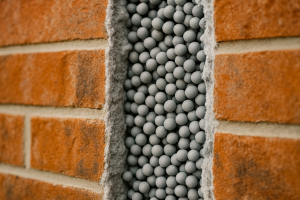
Polystyrene bead fill, also known as EPS bead, is injected into the cavity as small expanded polystyrene balls mixed with an adhesive. It fills the cavity thoroughly, including around obstructions like wall ties and service pipes, and it performs well in a range of cavity widths. It is widely used in areas with moderate weather exposure.
Polyurethane foam fill is a rigid foam injected into the cavity where it expands to fill the space. It achieves an excellent U-value per unit of thickness and is particularly useful in narrow cavities where other materials may not fill completely. It has attracted some controversy in recent years because removal is extremely difficult if problems arise, and some mortgage lenders have been cautious about properties with foam cavity fill. A pre-installation survey will confirm whether foam is appropriate for your specific property.
Before any cavity insulation is installed, a survey must confirm that the cavity is clear of rubble, debris, and excessive mortar snots, that the wall ties are in reasonable condition, and that there are no existing damp issues that would be made worse by filling the cavity. A reputable installer will carry out this survey as a matter of course. Be cautious about any company offering cavity insulation without a prior survey.
Why the December 2026 Deadline Matters
ECO4 closes on 31 December 2026. There is no extension and no successor scheme confirmed to open immediately afterward. For eligible households, the window to access free cavity insulation through ECO4 is therefore genuinely time limited. Applications take time to process, surveys take time to book, and installation slots fill up as the deadline approaches.
Acting before the summer gives you the best chance of completing the process in time. Waiting until October or November means competing with a large volume of last minute applicants for a shrinking pool of available installer slots. Cavity insulation is one of the few energy efficiency measures where a fully funded installation is still widely accessible in 2026. Taking advantage of that while the opportunity exists is straightforwardly the right decision for any eligible household with an unfilled cavity wall.
See our case studies.