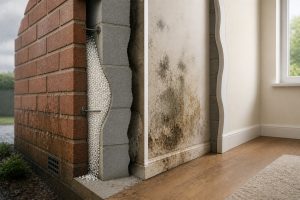
Cavity wall insulation does not cause damp in the majority of correctly installed cases, and raises the question does cavity wall insulation cause damp. But it does cause damp in specific, predictable circumstances , and north facing elevations in exposed locations are among the highest risk situations. If you have developed damp on a north facing wall after cavity wall insulation was installed, this article explains why it happens, what the mechanism is, and what can be done about it.
How Cavity Wall Insulation Is Supposed to Work
A cavity wall consists of two leaves of brick or block with a gap between them. The outer leaf faces the weather. The cavity provides a drainage path for any moisture that penetrates the outer leaf , water runs down the cavity face and exits at the base through weep holes or the damp proof course level. The inner leaf stays dry.
Cavity wall insulation fills that gap with mineral wool, EPS beads, or polyurethane foam. In a dry cavity with walls in good condition, the insulation fills the space without creating a moisture pathway. The outer leaf still gets wet, but the water drains down the face of the insulation rather than bridging across to the inner leaf.
This works as intended for the vast majority of UK cavity wall properties. The problem arises when the outer leaf allows more moisture to penetrate than the drainage capacity of the system can handle.
Why North Facing Elevations Are Different
A north facing wall in the UK has specific characteristics that make it more vulnerable than other elevations:
It receives no direct sunlight. Solar radiation is a significant driver of evaporation from brick surfaces. A south facing wall dries rapidly after rain. A north facing wall stays wet for much longer, which means the brickwork is saturated more often and for longer periods.
It faces prevailing wind in many locations. The UK’s prevailing wind is from the south west, which means north facing walls on properties in exposed locations often face directly into the wind. Driving rain on a north facing wall combines horizontal wind force with vertical rainfall to create a much greater volume of water striking the surface than falls vertically.
Mortar joints deteriorate faster. The freeze thaw cycle , water in mortar joints expanding as it freezes and contracting as it thaws , erodes mortar on exposed north facing elevations more rapidly than on sheltered or sunny elevations. Deteriorated mortar joints allow far more water into the outer leaf than sound pointing.
Biological growth increases moisture retention. Algae and moss grow more readily on damp, shaded surfaces. Once established, biological growth on mortar joints and brick faces increases moisture retention, accelerating the degradation that increases water ingress.
These factors combine to mean that a north facing elevation in an exposed location may allow significantly more moisture into the outer leaf than the same wall facing south. In an empty cavity, that moisture drains harmlessly. With insulation in place, the question is whether it reaches the inner leaf.
The Mechanism of Moisture Ingress Through Cavity Insulation
Mineral wool insulation does not wick water across the cavity in the same way that a damp brick bridges moisture. But it can transmit moisture under certain conditions:
Saturation of the insulation. If the volume of water entering through the outer leaf exceeds the drainage capacity , either because the insulation is compressed against the outer leaf in places, because mortar snots or debris on the insulation surface hold water, or because the rate of ingress simply overwhelms drainage , the insulation becomes wet. Wet mineral wool loses most of its thermal resistance and, if continuously wet, can transmit moisture to the inner leaf.
Bridging at cavitiy trays and lintels. Above window and door openings, cavity trays direct water out through weep holes at lintel level. If these trays were not installed correctly, or if the insulation installation bridged the tray, water accumulates above the lintel and tracks inward.
Compromised pointing. Mortar joints in very poor condition allow water to enter the cavity not just through capillary absorption but in volume. At this rate of ingress, the drainage capacity of the insulation system is overwhelmed regardless of exposure.
How to Diagnose Whether Insulation Is the Cause
Not all damp on a north facing wall after cavity wall insulation is caused by the insulation. Other causes include:
Condensation. If the property has increased in air tightness following insulation (which it does, slightly) and ventilation has not improved accordingly, condensation can increase on cold walls. Condensation damp tends to appear at cold bridges , corners, areas with less insulation , and is worse in winter and during humid periods.
Independent damp sources. Leaking gutters or downpipes, a failed damp proof course, improper wall insulation or plumbing leaks can all cause wall damp that is unrelated to the insulation.
Pre existing damp revealed by the insulation. Some properties have historic damp that was masked by cold, dry conditions in the cavity. Filling the cavity with insulation changes the thermal conditions in the wall and can make pre existing moisture migration more visible.
A thermal imaging survey of the internal elevation in cold weather is the most reliable diagnostic tool. A qualified thermographer can distinguish between insulation related moisture bridging, condensation, and other sources of damp from the pattern and characteristics of the thermal signature.
A borescope inspection , inserting a small camera through a drilled hole in the mortar joint , allows visual inspection of the insulation and cavity condition and can confirm whether the insulation is wet or compressed.
What You Can Do About It
Remedial Pointing
If the primary cause of moisture ingress is deteriorated mortar joints, repointing the north facing elevation , using a mortar mix appropriate to the brick type and exposure level , reduces the volume of water entering the outer leaf to a level the insulation system can manage.
This is often the most cost effective first step and can resolve the problem without any intervention to the insulation itself.
Cavity Wall Insulation Extraction
If the insulation is wet, compressed, or otherwise compromised, extraction may be necessary. A specialist contractor drills holes through the outer leaf and vacuums out the insulation material. The holes are re plugged with matching mortar.
After extraction, the cavity returns to its original empty state. The wall should then be assessed for the cause of moisture ingress and any masonry defects addressed before considering whether to re insulate , and if so, with what system.
Replacement with EPS Beads
Where extraction is followed by re insulation, EPS beads are often specified rather than mineral wool on vulnerable elevations. EPS beads do not absorb water and are bonded in place with an adhesive, which prevents slumping over time. They perform better than mineral wool in high moisture environments because they do not lose thermal resistance when wet in the same way.
External Wall Insulation
For properties where cavity insulation has persistently failed and the wall construction and exposure make it unsuitable for re insulation, EWI on the problematic elevation replaces the function of the original cavity system entirely. EWI sits outside the wall and provides a weather resistant barrier that prevents moisture from reaching the cavity or the structural wall.
Before Cavity Wall Insulation Is Installed: What a Good Survey Should Include
If you are considering cavity wall insulation and have a north facing elevation, the survey should assess:
Exposure rating. The surveyor should classify the site exposure using a recognised methodology and determine whether it falls within the suitable range for the chosen system.
Mortar joint condition. The pointing on the north facing elevation specifically should be inspected. Any deteriorated or open joints should be identified as requiring repointing before installation.
Cavity condition. A borescope inspection confirms whether the cavity is clear of debris, has adequate width, and shows any signs of existing moisture.
Existing damp. Any existing damp on the north facing elevation should be investigated before installation, not after.
An installer who does not assess these factors before proceeding on a north facing exposed elevation is taking a risk with your property.
Frequently Asked Questions: Does Cavity Wall Insulation Cause Damp
Should I get cavity wall insulation on a north facing wall? It depends on the condition of the pointing, the exposure level, and the existing cavity condition. A properly conducted survey should give you a clear answer. Do not proceed if the surveyor has not specifically assessed the north facing elevation for moisture risk.
How do I know if my insulation has failed? Damp patches appearing on the internal face of external walls after rainfall, particularly on the north facing elevation, are the primary indicator. A thermal imaging survey and borescope inspection confirm the diagnosis.
Is extraction guaranteed to fix the damp? Extraction removes the moisture pathway through the insulation, but the underlying cause , deteriorated pointing, a failed cavity tray, or another masonry defect , also needs addressing. Extraction without remedying the root cause will not provide a lasting fix.
Can I claim compensation if cavity wall insulation caused damp on my property? If the installation carries a CIGA guarantee, CIGA investigates complaints and can fund remedial work where the installation is found to have caused damage. Raise a formal complaint with CIGA with supporting evidence , survey reports, photographs, and records of when the problem started.
 Information correct as of April 2026. If you suspect cavity wall insulation is causing damp, commission a professional survey before taking any remedial action.