Removing cavity wall insulation is not the first thing most landlords expect to be thinking about in the context of the 2030 EPC C deadline. The instinct is to add insulation, not take it out. But for a significant number of rental properties across the UK, the cavity insulation that was installed under previous grant schemes is performing poorly, causing damp, or is simply unsuitable for the wall construction it was injected into. For these properties, removing cavity wall insulation is not a setback. It is the necessary first step before the correct upgrade can be installed and before the property can genuinely improve its EPC rating.
The scale of the issue is more significant than is often acknowledged. Cavity wall insulation was delivered at scale under ECO and predecessor schemes throughout the 2000s and 2010s, and in many cases properties were assessed as suitable when they were not. Exposed elevations, partial fill cavities, walls with existing damp issues, and non-standard constructions were all sometimes treated with standard blown insulation. The consequences in many of those cases have been persistent damp, internal mould, and a wall that performs worse thermally than it did before because the insulation is wet, compacted, or bridging the cavity incorrectly.
Signs That Cavity Insulation May Need to Be Removed
Landlords with rental properties should be alert to the following indicators that existing cavity insulation is failing. Persistent damp patches on internal walls, particularly on north facing or exposed elevations, that appeared or worsened after insulation was installed. Mould growth on internal wall surfaces in rooms that were previously dry. Tenants reporting cold spots on walls despite the property having cavity insulation. A deteriorating EPC rating despite insulation being present, which can happen when wet insulation performs significantly below its rated thermal value.
Any of these symptoms warrants a professional inspection rather than a cosmetic fix. A specialist cavity wall insulation surveyor can carry out a borescope investigation, drilling a small access hole and inserting a camera to assess the condition of the fill. This inspection will reveal whether the insulation is intact, partial, wet, slumped, or bridging the cavity in a way that is causing moisture transfer. The inspection report provides the basis for deciding whether removal and reinstatement is necessary.
Removal is also sometimes required for structural reasons. Some cavity wall insulation materials, particularly certain early polyurethane foam installations, have been associated with corrosion of wall ties and structural concerns. Mortgage lenders and surveyors increasingly flag these installations, and for landlords looking to refinance or sell properties in their portfolio, the presence of problematic foam cavity fill can be a significant obstacle.
How Cavity Wall Insulation Removal Works
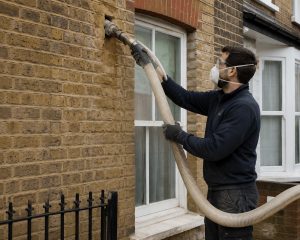
Removing cavity wall insulation is a specialist process carried out by registered contractors. The most common approach for blown fibre or bead fill involves drilling a pattern of extraction holes through the outer leaf of the wall, inserting a vacuum extraction hose, and drawing the insulation material out under negative pressure. The holes are then filled and pointed to match the existing brickwork as closely as possible.
For polyurethane foam, removal is considerably more complex. Foam bonds to the wall surfaces and cannot be extracted in the same way as loose fill. Removal typically requires mechanical extraction through larger access holes and is more expensive and time consuming. In some cases a full removal is not achievable and the options are limited to removal of as much material as possible combined with specialist remediation of the affected areas.
The cost of removal varies significantly depending on property size, material type, and the extent of the contamination. For a standard semi-detached house with blown fibre or bead fill, costs typically range from £1,500 to £4,000. Foam removal is typically higher, often between £3,000 and £8,000 or more for complex installations.
What Comes After Removing Cavity Wall Insulation
Once defective insulation has been removed, the cavity needs to be left open for a period to dry out before any new insulation is installed. A post-removal inspection confirms that the cavity is clear, dry, and in suitable condition for reinstatement. At that point, the property can be re-insulated with an appropriate material, correctly specified for the wall construction and exposure level.
This is also the point at which EPC improvement becomes possible. A property with failed cavity insulation that is damp or thermally ineffective will not benefit from the insulation on paper because the EPC assessor will note its presence, but the actual thermal performance will be poor. After removal and correct reinstatement, the EPC assessment reflects the real performance of the wall and the rating improves accordingly.
For landlords facing the 2030 EPC C deadline, removing cavity wall insulation that is failing is therefore not a delay to compliance. It is the route to compliance. A property with defective insulation that stays below EPC C is a non-compliant property from October 2030. A property that is correctly remediated and re-insulated is one that stands a genuine chance of reaching the required rating, accessing any available grant funding for the reinstatement, and remaining legally lettable.
The practical advice is to carry out a borescope survey on any rental property where you have any doubt about the condition of existing cavity fill. The cost of the survey is modest. The cost of leaving defective insulation in place, and discovering the full extent of the problem in 2029, is considerably higher.