The wall insulation Liverpool homeowners need is shaped by the city’s extraordinary concentration of Victorian and Edwardian solid wall housing. Liverpool expanded rapidly during the nineteenth century on the back of its port economy, and the result is a city where a very high proportion of the housing stock was built before 1920. Neighbourhoods like Toxteth, Kirkdale, Everton, and Kensington are dominated by solid brick terraces that have no cavity and therefore require a different insulation approach from the post war housing that makes up much of the rest of England. This guide gives Liverpool and Merseyside homeowners a clear picture of their wall insulation options in 2026.
Why Liverpool’s Wall Construction Makes Insulation Different
The critical distinction in Liverpool’s housing stock is the prevalence of solid brick construction. A solid wall is a single unbroken thickness of brick or stone. Because there is no internal cavity, you cannot drill holes in the mortar joints and inject insulation the way you can with a post war semi detached house. Therefore, Liverpool homeowners with Victorian or Edwardian properties face a different set of options from those available in newer homes.
Furthermore, Liverpool’s coastal exposure and its prevailing westerly winds from the Irish Sea mean that heat loss through uninsulated solid walls is significant. Cold and damp air constantly presses against the external fabric of older Liverpool properties. Solid walls that are not insulated conduct heat outward rapidly, and the result is higher energy bills and colder rooms than the thermostat setting would suggest.
In addition to the Victorian terraces, Liverpool also has a substantial stock of post war housing built across Norris Green, Speke, Croxteth, and Netherly. These properties typically have cavity walls and are suitable for standard cavity wall injection insulation. If your Liverpool home was built after approximately 1920 and before the mid 1990s, cavity wall insulation is likely to be a viable and cost effective option.
Options for Solid Wall Properties in Liverpool
For Liverpool homeowners with solid walls, the two main options are external wall insulation and internal wall insulation.
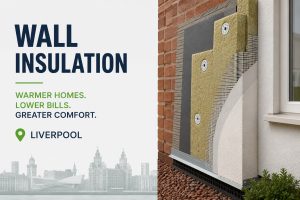
External wall insulation applies an insulating layer to the outside of the building and covers it with a render or cladding finish. It is thermally effective, does not reduce internal room sizes, and addresses cold bridging at corners, window reveals, and floor junctions. However, it does alter the external appearance of the property. In Liverpool’s conservation areas, which include parts of the city centre and several historic residential neighbourhoods, planning permission may be required. Always confirm with Liverpool City Council’s planning department before proceeding.
Internal wall insulation is fitted on the inside face of the external walls. It does not change the exterior appearance, which makes it more practical in sensitive planning contexts. However, it does reduce the internal floor area of every room it is installed in. In a typical Liverpool terrace where rooms are already modest in size, this is a meaningful consideration.
The Energy Saving Trust provides detailed guidance on both approaches at their solid wall insulation advice page.
How Much Does Wall Insulation Cost in Liverpool in 2026?
Liverpool labour costs are generally competitive, broadly in line with the north west average. As a guide for 2026:
Cavity wall insulation in a Liverpool semi detached property typically costs between 700 and 1,700 pounds.
External wall insulation for a Liverpool solid wall terrace typically costs between 7,000 and 15,000 pounds depending on property size and render specification.
Internal wall insulation for a Liverpool Victorian terrace typically costs between 4,500 and 10,000 pounds for a full treatment.
Always get at least three quotes based on surveys of your specific property. Prices vary depending on wall condition, accessibility, and the level of finishing work required.
For a complete overview of wall insulation types and what each option involves, our full wall insulation guide is a helpful resource.
Grants for Wall Insulation in Liverpool
Liverpool homeowners are well positioned for grant support in 2026. The ECO4 scheme and the Great British Insulation Scheme both cover wall insulation for eligible households. Liverpool’s household income profile and housing stock characteristics mean that a significant number of properties in the city qualify.
Liverpool City Council and the Liverpool City Region Combined Authority have both supported energy efficiency programmes in recent years. It is worth contacting your energy supplier and your local council to find out what funding is currently available in your area.
For EPC related questions and to understand how wall insulation will affect your property’s energy performance rating, our sister site has everything you need: EPC certificates.
How Long Does Wall Insulation Take in a Liverpool Home?
Cavity wall insulation in a standard Liverpool property typically takes one day from start to finish.
External wall insulation for a Liverpool terrace typically takes two to three weeks, including preparation, insulation board installation, and render finishing.
Internal wall insulation timescales vary by the number of rooms being treated. A single room takes two to three days. A full house treatment typically takes two to three weeks and requires rooms to be cleared and redecorated after the boards are installed.
Ready to Insulate Your Liverpool Home?
 Our team helps Liverpool and Merseyside homeowners understand their wall type, find the right insulation solution, and connect with trusted local installers.
Contact us today for a free, no obligation consultation covering all areas of Liverpool and Merseyside.