Cavity wall insulation removal is not a decision to take lightly. Extraction is expensive, disruptive, and does not automatically solve the problem that prompted the question. But in the right circumstances it is the correct course of action, and proceeding without it when it is needed only allows the underlying problem to worsen. This guide walks through the specific situations where removal is the right call, the situations where it is not, and what the process involves.
Why Removal Becomes a Consideration
Most homeowners who ask about cavity wall insulation removal are doing so because they suspect the insulation is causing damp on internal walls. A smaller number have had a professional survey that confirmed insulation related moisture bridging. Some are planning renovation work that requires access to the cavity.
The starting point in every case is the same: a proper diagnosis. Damp on an internal wall following cavity wall insulation installation is not proof that the insulation is the cause. It is a signal that investigation is needed. Removing the insulation without understanding why the damp occurred risks extracting material that was performing adequately while leaving the actual cause, a leaking gutter, a failed lintel tray, poor pointing, unaddressed. Checking your floor insulation is also worth looking into.
Before considering removal, commission a survey that includes thermal imaging of the affected walls and a borescope inspection of the cavity. This tells you whether the insulation is wet, whether it has bridged the cavity, and whether the damp pattern matches what you would expect from insulation failure versus other causes.
When Removal Is the Right Decision
The Insulation Is Wet and Has Been for an Extended Period
Wet mineral wool loses most of its thermal resistance and, if it remains wet continuously, creates a sustained moisture bridge across the cavity. A borescope inspection that shows wet, degraded material, combined with thermal imaging showing cold spots and internal damp on exposed elevations, indicates extraction is the correct course.
Wet insulation that dries out following identification of the moisture source may not need extraction, the material can recover some of its performance if the ingress is stopped. But insulation that has been wet for years, that has compressed or settled, or that contains debris and contamination is not going to recover.
The Property Is in a High Exposure Location and Suffers Persistent Damp
Some properties simply should not have had cavity wall insulation installed. Exposed locations, coastal, upland, or north facing elevations on open sites, can experience driving rain loads that overwhelm the drainage capacity of cavity insulation, particularly mineral wool. If the installation has caused persistent damp that cannot be resolved through repointing or maintenance, and the exposure level is the root cause, removal and a different approach (such as EWI) is the appropriate response.
The Insulation Was Installed in a Non Standard Wall Type
No fines concrete, Mundic block, and other non standard construction types are not suitable for standard cavity wall insulation. If insulation was injected into a wall that should not have received it, removal is typically the correct response.
You Are Planning EWI and the Existing Cavity Fill Has Failed
If you are moving to external wall insulation because the cavity fill has failed, the question arises of whether to extract first or leave the existing insulation in place and add EWI on top. In most cases the EWI specification does not require extraction of existing cavity fill, the EWI performs regardless of what is in the cavity. However, if the existing cavity fill has driven moisture into the inner leaf, the structural wall may need time to dry out before EWI is applied. Your installer should assess this.
When Removal Is Not Necessary
The Insulation Is Performing and You Simply Want Better Thermal Performance
If your insulation is dry, complete, and performing as intended, extraction and replacement with a different system is unlikely to be cost effective. EWI can be added on top of a working cavity fill installation to further improve performance.
The Damp Is From a Different Source
Leaking gutters, failed damp proof courses, rising damp, and plumbing leaks all cause internal damp that has nothing to do with cavity wall insulation. Removing the insulation in response to damp caused by a leaking gutter does not fix the gutter.
A thorough diagnosis is always the starting point. Do not authorise extraction until the cause of the damp is understood.
You Plan to Sell the Property in the Near Term
Extracted cavity wall insulation reduces the property’s EPC rating and removes an energy efficiency measure that buyers and mortgage lenders increasingly value. Unless the existing insulation is demonstrably causing harm, extraction before a sale is counterproductive.
What the Extraction Process Involves
Cavity wall insulation extraction is a specialist job. The process works as follows:
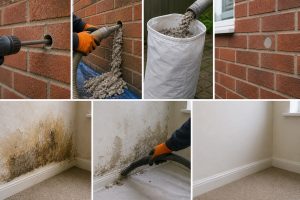
Survey and access planning. The contractor surveys the property, identifies the injection hole grid, and plans the extraction sequence. On most properties, extraction holes are drilled at the same positions as the original injection holes plus additional holes at the base of each elevation to allow complete removal.
Drilling. A grid of holes typically 22mm in diameter is drilled through the mortar joints of the outer leaf. Drilling through mortar rather than brick minimises damage to the masonry and makes plugging easier.
Vacuum extraction. A high powered industrial vacuum connects to each hole in sequence. The suction pulls the insulation material out through the hole and into the collection unit. Mineral wool extracts relatively easily. EPS beads can be more challenging to collect completely. Polyurethane foam is the most difficult to extract and may require mechanical agitation.
Plugging. Each hole is plugged with a mortar plug matched as closely as possible to the existing mortar colour and texture. On a relatively new installation, the plugs are barely visible. On older brickwork, some colour variation is inevitable.
Inspection. A post extraction borescope inspection confirms that the material has been removed from the full height of the cavity at representative points across each elevation.
The whole process typically takes one to two days for a semi detached property. The property is habitable throughout, there is no need to vacate.
How Much Does Extraction Cost?
Extraction costs in 2026 range from:
| Property type | Approximate extraction cost |
|---|---|
| Mid terrace (two elevations) | £1,200 to £2,500 |
| Semi detached (three elevations) | £1,500 to £3,500 |
| Detached (four elevations) | £2,000 to £4,500 |
Costs vary with the material type (foam is more expensive to extract than wool or beads), the accessibility of the property, and the contractor. Get at least two quotes from specialist extraction contractors rather than general installers.
Can You Claim the Cost Back?
If the installation carries a CIGA guarantee and the extraction is needed because of a defective installation, CIGA may fund the remedial work following an investigation. Raise a formal complaint with CIGA before commissioning extraction commercially, as self funded extraction may not be reimbursable after the fact.
If the installation was carried out through an ECO scheme without a CIGA guarantee, contact the scheme operator or the energy company that funded the installation to raise a complaint.
After Extraction: What Next?
Once extraction is complete and the underlying cause of any moisture problem has been addressed, the options are:
Leave the cavity empty. The wall returns to its pre insulation thermal performance. For a property in a high exposure location where re insulation is not suitable, this may be the correct end point, combined with EWI if improved thermal performance is needed.
Re insulate with EPS beads. EPS beads perform better than mineral wool in wet conditions and are suitable for re insulation on most property types. The extraction and re insulation can sometimes be done in a single visit by a specialist contractor.
Install EWI. For properties where the cavity is unsuitable for re insulation, EWI achieves improved thermal performance without engaging the cavity.
Frequently Asked Questions
Will removing cavity insulation fix my damp problem? Only if the insulation is the cause of the damp. If the damp comes from a different source, extraction will not help. Always diagnose before extracting.
How do I find a specialist extraction contractor? Look for contractors who specifically advertise cavity wall insulation extraction. Check that they are TrustMark registered and ask for examples of previous extraction projects. Not all insulation installers carry out extraction, it requires specialist equipment.
Does extracted cavity insulation go to landfill? Mineral wool and EPS can both be recycled. A responsible contractor should use a waste carrier that handles the material appropriately. Ask about disposal before appointing.
If I remove the insulation, can I get it reinstalled under a grant scheme? Possibly. If your household meets the eligibility criteria for ECO4 or GBIS, a new cavity wall insulation installation may be funded after extraction. Check current eligibility with a registered installer.
 Information and cost ranges correct as of April 2026. Always obtain a professional diagnosis before commissioning cavity wall insulation extraction.