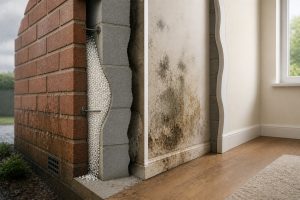
Does cavity wall insulation cause damp, or is the wet winter of 2025 to 2026 to blame? After England recorded its eighth wettest winter on record, with rainfall running 42% above the long term average according to the Met Office, more properties than usual are showing moisture on their walls this spring. The key question is not just whether damp is present. It is what type of damp it is, what is driving it, and whether cavity wall insulation is genuinely the cause or is being unfairly blamed.
Cavity Wall Insulation and Damp, is it Just the Weather?
This question matters enormously before spending money on remedial work. Cavity wall insulation does not cause damp in the majority of correctly installed cases. However, it does cause damp in specific, predictable circumstances, and a winter as severe as this one creates several of those circumstances simultaneously.
The winter of 2025 to 2026 was exceptional. Southern England recorded its fourth wettest winter in over a decade. The West Midlands, Cornwall and Leicestershire each saw their wettest winter since records began in 1836. Parts of England experienced 41 consecutive days of rain. As a result, building fabric across the country entered spring in a state of unusual saturation. Ground water levels are elevated. External wall materials have absorbed more moisture than in a typical winter. And as temperatures rise in April and May, all of that moisture is moving, looking for somewhere to go.
This is why so many homeowners are asking: does cavity wall insulation cause damp, or is what I am seeing simply moisture from a record wet winter?
Cavity Wall Insulation and Damp: Understanding Winter Damp
Winter damp driven by condensation appears at its worst between November and February. It concentrates at cold bridges, corners, areas behind furniture, around window frames, and on external walls facing north or northeast. The mechanism is condensation: cold surfaces fall below the dew point of indoor air, and moisture in the air condenses onto them.
Winter condensation damp has specific characteristics. It appears on internal surfaces rather than soaking through from outside. It is worse in rooms with high humidity. It correlates with cold temperatures rather than rainfall. And it typically responds to improved ventilation and, more permanently, to wall insulation that raises the surface temperature above the dew point.
Cavity Wall Insulation and Damp: Understanding Spring Damp
Spring damp is a different problem with a different mechanism. It often develops in March, April and May, sometimes in properties that appeared dry throughout winter. After a wet winter like this one, spring damp can affect properties that have never previously shown signs of moisture.
The mechanism is moisture migration. External wall materials that absorbed large volumes of water during a sustained wet winter begin to dry as temperatures rise and rainfall reduces. Moisture moves through the wall fabric toward whichever face loses it fastest. Where external walls are still cold and internal environments are warm and heated, moisture migrates inward, appearing as damp patches on the inner face as it evaporates into the room.
So does cavity wall insulation cause this spring damp? It can, in specific circumstances. If the insulation is saturated, settled or compressed, conditions that this winter has created in many properties with older mineral wool installations, it can act as a moisture bridge rather than a drainage path.
How to Diagnose the Difference
Getting the diagnosis right before spending money is essential. Several questions help distinguish the causes:
When does the damp appear? Condensation damp peaks in the coldest months. Moisture migration and insulation related bridging often peak in spring.
Where does the damp appear? Condensation concentrates at cold bridges. Cavity wall insulation related damp tends to appear more broadly across the wall face on exposed or north facing elevations.
Does it correlate with rainfall or temperature? Condensation correlates with cold. Insulation related moisture bridging often worsens during or after sustained rain on exposed elevations.
Does a dehumidifier help? Dehumidifiers reduce condensation damp. They have limited effect on damp caused by moisture bridging through cavity insulation.
A thermal imaging survey removes most uncertainty. An infrared camera distinguishes between cold bridges generating condensation and moisture present within the wall fabric from insulation failure or saturation.
What Cavity Wall Insulation Does and Does Not Fix
Cavity wall insulation directly addresses condensation damp by raising the inner wall surface temperature. This is one of its primary benefits and why so many homeowners find damp problems resolve after installation.
However, cavity wall insulation does not address moisture migration from a saturated wall if the cause of that saturation is not also resolved. Installing insulation on a wall with deteriorated mortar joints does not fix the mortar. The correct sequence is: diagnose the type and cause of damp accurately, address the root cause, allow the wall to dry, then install the appropriate insulation.
For cavity wall insulation problems specifically, where the insulation itself has failed or been compromised by this winter’s moisture, visit our guide to cavity wall insulation problems.
Frequently Asked Questions
Does cavity wall insulation cause damp in new installations?
A correctly surveyed and installed cavity wall insulation system in a property with sound walls and adequate exposure rating should not cause damp. Problems arise when surveys miss existing issues or when the exposure level makes the property unsuitable for cavity fill.
Does cavity wall insulation cause damp more on north facing walls?
Yes, in high exposure conditions. North facing walls receive no solar drying and are more susceptible to sustained saturation. After a wet winter like this one, north facing elevations are the highest risk location for insulation related moisture bridging.
Should I remove my cavity wall insulation if I suspect it is causing damp?
Not without a professional diagnosis first. Extraction is expensive and may not be necessary. A thermal imaging survey and borescope inspection will confirm whether the insulation is the cause before any remedial action is taken.
Can spring damp from a wet winter resolve on its own?
Moisture migration from a saturated wall often reduces significantly over summer as the wall dries. However, if the underlying cause, deteriorated mortar, failed insulation, is not addressed, the same pattern will recur every winter.