Cavity wall insulation problems have surged this spring, and England’s record wet winter of 2025 to 2026 is the direct cause. If your property has filled cavities and you have noticed damp patches, cold spots, or increased heating costs since February, your cavity wall insulation may be among the millions of installations now under serious strain. Understanding what has gone wrong, and what the data shows, is the first step toward fixing it.
The Winter That Made Cavity Wall Insulation Problems Worse
The Met Office confirmed in March 2026 that England recorded its eighth wettest winter on record, with rainfall running 42% above the long term average. Southern England saw its fourth wettest winter in over a decade. The West Midlands, Cornwall and Leicestershire each recorded their wettest winter since 1836. In parts of the country, it rained on 41 consecutive days.
For cavity wall insulation, the distinction between heavy downpours and sustained saturation is critical. A brief shower may penetrate the outer leaf and drain harmlessly down the cavity face. Weeks of continuous rain, particularly on north facing elevations with deteriorated mortar, can overwhelm the drainage capacity of cavity insulation entirely. That is precisely what happened this winter across much of southern and central England.
How Cavity Wall Insulation Problems Develop Under Prolonged Wet Conditions
Mortar Deterioration and Increased Water Ingress
The wet winter included multiple freeze thaw cycles. Water in mortar joints freezes, expands and physically breaks down the mortar matrix. After repeated cycles across a sustained wet season, previously borderline joints are now more open, allowing greater water ingress into the outer leaf than was occurring last autumn. This is one of the most common cavity wall insulation problems in older properties.
North Facing Elevation Cavity Wall Insulation Problems
North facing walls faced particular pressure this winter. Properties with north or north east facing elevations receive no direct solar drying between October and March. They stay damp between rain events rather than drying. Over a winter like this one, sustained saturation of the outer leaf combined with insufficient drainage creates exactly the conditions that cause moisture to bridge across to the inner leaf through the insulation.
Older Mineral Wool Installations
Cavity wall insulation problems are most severe in properties with mineral wool installed in the 1980s or 1990s. The material may have settled over 30 or 40 years, leaving voids at the top of the cavity. Where it remains in place, it may have absorbed moisture from previous wet events without fully drying. After a winter of this severity, the condition of older mineral wool deserves immediate assessment.
Signs That Cavity Wall Insulation Problems Are Affecting Your Property
As spring arrives and moisture built up over winter begins to move, several signs indicate that cavity wall insulation problems may be present:
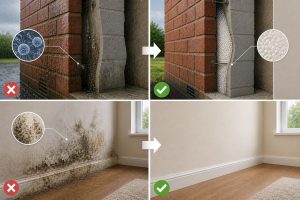
New damp patches appearing in spring. Moisture that entered the outer leaf over winter begins migrating inward as temperatures rise. New damp patches in March, April or May, particularly on north facing or exposed walls, are a clear warning sign.
Cold spots on internal walls. A thermal imaging survey reveals cavity wall insulation problems clearly. Wet mineral wool loses most of its thermal resistance. Cold spots in spring that were not present in autumn suggest moisture related degradation.
Increased heating costs despite mild temperatures. If your heating system works harder than usual in mild spring weather, reduced insulation performance is a likely explanation.
Mould on internal wall surfaces. New mould appearing on external walls in spring, on walls that were previously dry, suggests moisture migration through the wall fabric.
Diagnosing Cavity Wall Insulation Problems Correctly
The correct response to suspected cavity wall insulation problems is a professional survey, not guesswork. A thorough survey includes:
Thermal imaging of internal wall surfaces. An infrared camera reveals heat loss patterns clearly. Cold patches, voids and moisture pathways all appear as distinct signatures, the most reliable diagnostic tool available.
Borescope inspection of the cavity. A small camera inserted through a drilled hole in the mortar joint allows direct visual inspection. Wet, compressed or settled material is immediately visible.
Assessment of mortar joint condition. After this winter, external mortar on north facing and exposed elevations deserves specific attention. A surveyor will identify joints that need repointing before any remedial action on the insulation itself.
How to Resolve Cavity Wall Insulation Problems After a Wet Winter
Repointing. Where deteriorated mortar joints are the primary cause, repointing the affected elevation restores the weather barrier and allows the insulation to dry out and recover performance, provided the material itself is not permanently degraded.
Extraction and replacement. Where the insulation is wet, compressed or significantly degraded, extraction is the appropriate response. A specialist contractor removes the material through drilled holes and replaces it with EPS beads, which perform better in high moisture environments because they do not absorb water.
External wall insulation. For properties where cavity wall insulation problems have repeatedly occurred and the exposure level makes re filling inadvisable, EWI bypasses the cavity entirely and provides superior thermal performance without the moisture risks. For more information on this option, visit ecoinsulation.co.uk.
Frequently Asked Questions
How do I know if my cavity wall insulation problems are caused by this winter’s rainfall?
The most reliable way is a thermal imaging survey and borescope inspection. Surface signs include new damp patches on internal walls on exposed elevations and increased heating bills despite milder weather.
Can cavity wall insulation recover after a wet winter?
EPS beads recover well because they do not absorb water. Mineral wool that has been wet for an extended period may recover partial performance but does not always return to its original thermal resistance, particularly if it has settled or compressed.
Does a CIGA guarantee cover cavity wall insulation problems from exceptional weather?
The CIGA guarantee covers installation defects. If the installation was correctly done and the damage results from exceptional weather, the guarantee may not apply. However, if a property’s exposure level should have prompted a recommendation against filling the cavity and that recommendation was not made, there may be grounds for a complaint.
How often should I check for cavity wall insulation problems?
 Every five to ten years is good practice. After an exceptional wet season like this one, a check is warranted regardless of when the last survey was done.