Choosing between internal external wall insulation options is one of the most common dilemmas for English homeowners with solid walls. Both approaches work. Both have real drawbacks. The right choice depends on your property, your budget, and what you are willing to live with during and after installation. This guide gives you an honest comparison so you can decide with confidence.
Why Solid Wall Homes Need a Choice at All
Homes built before the 1930s in England typically have solid brick or stone walls with no cavity. Because there is no gap to fill, the only way to add insulation is to attach it to either the inside or the outside of the wall. Each approach involves trade-offs that cavity wall insulation does not.
If your home has cavity walls, this decision does not apply to you. Cavity wall insulation fills the existing gap with minimal disruption and is almost always the right choice.
What Is Internal Wall Insulation?
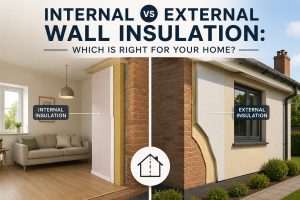
Internal wall insulation fixes insulated boards or a timber frame filled with insulation to the inner face of an external wall. The insulation sits inside the room, so the work happens entirely within the property.
The main advantage is that the external appearance of the building does not change. This matters for properties in conservation areas, listed buildings, or streets with strict planning controls. Furthermore, you can insulate one room at a time, which makes it easier to phase the work and manage costs.
The main disadvantages are room size and disruption. Each insulated wall reduces the floor area of the room by 75mm to 150mm. Skirting boards, window reveals, radiators, and electrical sockets all need to be moved. As a result, the room is effectively rebuilt after insulation.
What Is External Wall Insulation?
External wall insulation fixes an insulation board to the outside face of the wall, which is then covered with a render or cladding finish. The work happens entirely outside the property.
The main advantage is that the interior of the home is completely undisturbed. Rooms retain their full size. Heating systems, sockets, and fittings stay in place. In addition, external insulation wraps the entire building envelope, which eliminates cold bridges at floor and ceiling junctions more effectively than internal insulation.
The main disadvantages are cost, appearance, and planning. External insulation costs more than internal insulation and changes the look of the building. Properties in conservation areas or with certain lease restrictions may not be able to use this approach without consent.
Internal vs External Wall Insulation: Side by Side
- Room size: Internal insulation reduces room size by 75mm to 150mm per wall. External insulation has no impact on room size.
- Disruption: Internal insulation causes significant internal disruption. External insulation causes no internal disruption.
- Appearance: Internal insulation does not change the external appearance. External insulation changes the external appearance of the building.
- Cold bridges: Internal insulation is less effective at eliminating cold bridges at floor and ceiling junctions. External insulation eliminates cold bridges more thoroughly.
- Planning: Internal insulation rarely requires planning permission. External insulation may require permission in conservation areas or for listed buildings.
- Cost: Internal insulation typically costs £4,000 to £8,000 for a semi-detached house. External insulation typically costs £8,000 to £15,000 for the same property.
- Performance: Both achieve similar U-values when properly installed. External insulation has a slight advantage due to better cold bridge elimination.
Which One Should You Choose?
There is no single right answer. However, some situations point clearly in one direction.
Choose internal wall insulation if your property is in a conservation area or has strict planning controls. It also suits landlords who need to insulate a property without vacating tenants, and homeowners who want to phase the work room by room.
Choose external wall insulation if you want no internal disruption, if the building needs rerendering anyway, or if eliminating cold bridges is a priority. It also suits properties where all walls need treating at once and where planning restrictions do not apply.
For households who qualify for funding, wall insulation grants may cover part or all of the cost of either approach. See our guide to wall insulation grants in England.
What Do Building Regulations Require?
When you add insulation to an existing wall, Part L of the Building Regulations applies. It sets minimum thermal performance standards for the work. The Citizens Advice Bureau provides guidance on your rights and responsibilities when commissioning energy efficiency work:
Always use an installer registered with a competent person scheme. This ensures the work meets regulations without requiring a separate building control inspection.
 Not Sure Which Option Suits Your Property?
The right choice between internal and external wall insulation depends on factors specific to your home. Contact us today and we will assess your property, confirm your wall type, and recommend the most effective approach for your situation and budget.
Contact us for the right provider.