We use cookies to provide you with a better experience. By continuing to use this site, you agree to our use of cookies.

Why Wall Insulation Matters: A Complete Guide for UK Homes (2026)

Wall insulation is one of the biggest single upgrades you can make to the energy efficiency of a UK home. Walls account for around 35% of all heat loss in a typical uninsulated house, making them the largest source of wasted energy after the roof. This guide explains the different types of wall insulation, which is right for your property, what it costs, and how to access funding.


Why Wall Insulation Matters

The average UK home loses roughly a third of its heat through uninsulated walls. In practical terms, that means your boiler is working significantly harder than it needs to, your energy bills are inflated, and your property is harder to heat comfortably.


Insulating your walls:


  • Cuts heating bills by reducing the rate of heat loss
  • Improves thermal comfort — walls feel warmer to the touch and rooms heat up faster
  • Raises your EPC rating, which matters for property sales and increasingly for rental compliance
  • Reduces your carbon footprint
  • Can increase property value


The right type of insulation depends entirely on what kind of walls your home has.


Types of Walls in UK Homes

Before choosing a system, you need to know what type of wall construction your home has. There are two main categories.

Cavity Walls

Cavity walls have two separate leaves of brick or block with a gap (the cavity) between them. This construction became standard in the UK from the 1920s onwards. If your home was built after 1930, it is very likely to have cavity walls.


You can usually tell by looking at the brickwork: a regular stretcher bond pattern (all bricks laid lengthways) indicates cavity wall construction.

Solid Walls

Solid walls have no cavity. They are a single thickness of brick or stone. This was the standard construction method before the 1920s. Solid walls are significantly harder to insulate because there is no gap to fill.


Solid walls can be identified by an alternating bond pattern in the brickwork, where some bricks are laid end on (headers) and some laid lengthways (stretchers). Stone properties and many Victorian and Edwardian terraces are solid wall construction.


Types of Wall Insulation

Cavity Wall Insulation

For cavity wall properties, insulation is injected or blown into the existing cavity through small holes drilled in the outer wall. The holes are then sealed. The process takes a few hours and is minimally disruptive.


Materials used include:


Mineral wool (glass wool or rock wool) — the traditional and most widely used material. Delivered as loose fibres blown under pressure into the cavity.


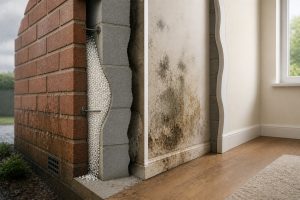
EPS beads — small polystyrene beads that fill the cavity and bond together with an adhesive. Perform better in exposed or wet locations than mineral wool.


Polyurethane foam — injected as a liquid that expands and sets. Higher thermal performance per unit thickness but more expensive.


Cavity wall insulation costs around £500 to £1,500 for a typical semi detached house and is often available fully funded through ECO4 or GBIS for eligible households.


Important: Cavity wall insulation is only suitable where the cavity is free from significant moisture ingress and the walls are in good structural condition. In exposed locations or with aged, failed cavity fill, problems can occur. Always have a survey by a CIGA (Cavity Insulation Guarantee Agency) registered installer.

External Wall Insulation

For solid wall properties, external wall insulation (EWI) is the most effective solution. Insulation boards are fixed to the outside of the building, then covered with a protective render or cladding system.


EWI does not reduce the internal floor area of the property, eliminates thermal bridging at junctions, and when done as a whole terrace or street project, dramatically improves the energy performance of the entire row.


Costs range from £6,000 to £14,000 for a typical semi detached property but significant grant funding is available through ECO4 and GBIS for eligible households.


[Read our full guide to external wall insulation →]

Internal

An alternative to EWI for solid wall properties. Insulation boards or a stud wall filled with mineral wool is installed on the inside face of external walls.


Advantages:


  • Does not affect the external appearance of the building — useful in conservation areas or for listed buildings
  • Can be done room by room


Disadvantages:


  • Reduces the internal floor area (typically 75 to 100mm per wall treated)
  • More disruptive — skirting boards, radiators, electrical sockets and window reveals all need to be repositioned
  • Harder to eliminate thermal bridges at floor, ceiling, and partition wall junctions


Internal wall insulation costs around £40 to £80 per square metre installed.

Hybrid or Combination Systems

Some properties benefit from combining systems — for example, cavity wall insulation on extensions built after the 1920s, with EWI or IWI on an earlier solid wall section of the same property.


A thorough survey will identify which sections of your walls have which construction type and recommend the appropriate solution for each.


Which Type of Insulation Do I Need?

Property Type Recommended System
Post 1930 cavity wall with unfilled cavity Cavity wall insulation
Pre 1920 solid brick or stone External wall insulation (preferred) or internal wall insulation
Listed building or conservation area Internal wall insulation or breathable EWI system (subject to planning)
Mixed construction property Survey to determine combination approach
Exposed location with damp cavity EPS bead cavity fill or solid wall system


If you are unsure what construction your walls are, a thermal imaging survey can identify heat loss patterns and confirm wall type and existing insulation status.


Wall Insulation Costs in 2026

System Typical Cost
Cavity wall insulation (semi detached) £500 to £1,500
External wall insulation (mid terrace) £6,000 to £9,000
External wall insulation (semi detached) £9,000 to £14,000
Internal wall insulation (per m²) £40 to £80


Costs vary with property size, wall condition, chosen system, and installer. Grant funding can bring costs down to zero for eligible households.


Wall Insulation Grants and Funding

ECO4 (Energy Company Obligation)

ECO4 requires larger energy suppliers to fund insulation measures for low income and fuel poor households. There is no strict income cap — eligibility is assessed based on your EPC rating, property type, and household circumstances. Both owner occupiers and private tenants can apply.

Great British Insulation Scheme (GBIS)

Aimed at households in lower council tax bands (A to D in England) or with a poor EPC rating (D or below). Provides fully or heavily subsidised insulation through registered suppliers and installers.

Home Upgrade Grant (HUG2)

For properties not on the mains gas grid with a household income below £36,000. Fully funded insulation is available through local delivery partners.

Warm Homes Local Grant

A successor scheme to HUG2 being rolled out from 2026. Contact your local authority for availability in your area.


To find out what you may qualify for, the quickest route is to contact a TrustMark registered, PAS 2030 certified installer who can run an eligibility check and manage the application process on your behalf.


Wall Insulation and Building Regulations

Any insulation that improves the thermal performance of the building envelope must comply with Part L of the Building Regulations (Conservation of Fuel and Power). Your installer should arrange building regulations approval and provide a completion certificate on sign off.


External wall insulation may also require planning permission in conservation areas or for listed buildings. Cavity wall insulation generally does not require planning permission.


How Much Can Wall Insulation Save on Bills?

Savings depend on which system is installed and the starting condition of the property.


System Estimated Annual Saving
Cavity wall insulation (semi detached) £130 to £250
External wall insulation (semi detached solid wall) £280 to £400
Internal wall insulation (semi detached solid wall) £250 to £370


Source: Energy Saving Trust estimates based on 2026 energy prices. Actual savings will vary.


Wall Insulation and Damp

A common concern is whether insulation can cause or worsen damp. The answer depends on the system, the quality of installation, and the existing condition of the property.


Cavity wall insulation can contribute to damp if the walls already suffer from driving rain penetration, if the cavity has bridging caused by debris, or if ageing cavity fill has failed. A survey should check for these risks before installation.


External wall insulation, when correctly installed with appropriate detailing at openings, junctions, and the base of the building, generally improves moisture performance by keeping the structural wall warmer and drier.


Internal wall insulation requires careful vapour control to avoid interstitial condensation. A vapour control layer is typically included in correctly specified systems.


Any existing damp issues should be diagnosed and treated before installing any wall insulation.


Choosing an Installer

Look for:


  • CIGA registration for cavity wall insulation
  • PAS 2030 certification for any work funded through ECO4, GBIS, or government schemes
  • TrustMark registration — the government endorsed quality mark
  • BBA or KIWA certification for the specific product system being installed


Get at least two quotes and check that the surveyor inspects the actual wall condition rather than quoting on property type alone.


Frequently Asked Questions

How long does wall insulation last?

Cavity wall insulation carries a 25 year guarantee under CIGA. External wall insulation systems last 25 to 40 years. Internal wall insulation lasts the lifetime of the building if correctly specified and installed.


Can I insulate just one wall?

Yes, though insulating the entire external envelope is more cost effective and eliminates more heat loss. Internal wall insulation in particular is often done room by room.


Will it cause condensation?

Correctly installed systems with appropriate vapour control should not cause condensation. Poorly installed systems, particularly internal insulation without a vapour control layer, can cause problems. Use a qualified installer.


Does wall insulation add value to my home?

EPC ratings influence property values and mortgage rates. Moving from an E or F rating to a C can have a measurable positive effect on sale price. The precise uplift depends on location and buyer demand.


Is it worth it?

For the vast majority of UK properties, yes. The payback period for cavity wall insulation is typically 3 to 5 years. EWI takes longer to pay back through energy savings alone but the comfort benefits, EPC improvement, and grant availability change the calculus significantly for many households.

image of wall insulation

Got a question? Get in touch.

Costs and grant information correct as of April 2026. Scheme eligibility and funding levels change regularly — always confirm current availability with a registered installer.


Party wall insulation: What it is and why it matters for UK homes

What is party wall insulation?

Party wall insulation involves adding insulating materials within or against a shared wall to reduce heat loss, limit sound transfer, and improve comfort in attached homes such as terraced and semi-detached houses. 

A party wall is the wall you share with your neighbour, and although it might seem that heat cannot escape through it, uninsulated party walls can allow warm air to travel out through gaps and cavities. This leads to heat loss, draughts, and higher energy bills. 

Insulating the party wall reduces air movement, improves thermal performance, and makes your home more energy efficient.

Why is party wall insulation important?

Party wall insulation is important because shared walls are significant sources of energy loss and noise disturbances if they are not insulated properly. Cavity party walls often create a thermal bypass effect where warm air escapes, and cold air infiltrates the home. This increases heating costs and lowers comfort. 

Insulating party walls stabilises indoor temperatures, reduces sound transmission between neighbours, and helps improve your home’s EPC rating. This is valuable for homeowners looking to cut bills, landlords aiming for compliance, and housing providers working toward sustainability targets.

How does party wall insulation work?

Party wall insulation works by filling gaps or lining the shared wall with insulating materials that reduce heat transfer and block air filtration through cavities. In homes with cavity party walls, insulation fills the gap to stop warm air rising and escaping through the loft space. 

For solid party walls, insulation is added via internal linings or stud walls that improve both heat retention and noise reduction. In both cases, the goal is to create a more consistent indoor environment by reducing unwanted air movement and minimising heat loss.

What types of party wall insulation are available?

The best type of party wall insulation depends on whether your wall has a cavity or is solid.

Cavity party wall insulation

Cavity party wall insulation involves injecting insulation materials into the cavity between the two properties. It is common in semi-detached and terraced houses built from the 1930s onward. Insulation types include mineral wool, polystyrene beads, and suitable foam products. This method is quick, minimally disruptive, and effective at reducing heat loss and noise. It also improves air tightness and helps prevent the stack effect, where warm air rises and escapes through uninsulated gaps.

Solid party wall insulation

For solid walls, insulation is installed internally, often using insulated plasterboard or rigid boards such as PIR. Mineral wool within a stud wall can also be used. These methods enhance thermal resistance and soundproofing and are often done alongside renovations, extensions, or property conversions. Solid wall solutions tend to add more thickness to the room but offer strong acoustic performance, making them popular in busy or noisy neighbourhoods.

Internal stud wall insulation

Internal stud wall insulation involves building a new stud wall beside the existing party wall and infilling it with insulation such as mineral wool or rigid boards. This option prioritises acoustic performance and is a strong choice for bedrooms, home offices, and living spaces. It is also commonly used in flats, where impact and airborne sound can be more noticeable.

What are the benefits of party wall insulation?

Party wall insulation offers numerous benefits for homeowners, landlords, and developers:

  • Reduced heat loss: Warm air stays inside your home instead of escaping through shared walls.
  • Lower energy bills: Improved insulation helps cut the cost of heating.
  • Better comfort: Eliminates cold spots and reduces draughts.
  • Improved soundproofing: Minimises noise transfer between adjoining homes.
  • Higher EPC ratings: A better EPC is beneficial for selling, renting, and compliance.
  • Increased property value: Energy-efficient homes tend to attract more interest.
  • Sustainability: Retaining heat reduces your carbon footprint and supports greener living.

For landlords and housing associations, better insulation can also lead to fewer tenant complaints, improved satisfaction, and long-term compliance with evolving energy standards.

How much does party wall insulation cost?

Costs vary by wall type, property size, and insulation method:

  • Cavity wall insulation ranges between £8 and £15 per square metre.
  • Internal insulation systems typically cost between £20 and £60 per square metre, including materials and labour.

Additional costs may be incurred for plastering, decoration, or skirting board adjustments. Party wall insulation is often more cost-effective when combined with broader renovation projects, such as soundproofing or energy upgrades, because labour and access can be coordinated. Developers and contractors may also find that bulk installations significantly reduce project-wide costs.

Do building regulations require party wall insulation?

Building regulations require party wall insulation mainly when constructing new dwellings or converting properties into separate units. In these cases, walls must meet thermal and acoustic standards, and building control officials will assess U-values and installation quality. For existing homes, party wall insulation is not mandatory but is strongly recommended, especially for cavity walls, to meet modern efficiency expectations and improve comfort. It also helps future proof a property as regulations continue to tighten.

Are grants available for party wall insulation?

Although few grants are solely for party wall insulation, funding may be available as part of broader home energy upgrades. These may include loft insulation, cavity wall insulation, or heating system improvements. Schemes include the ECO4 Scheme for low-income households, Local Authority Delivery programmes, and previously the Home Upgrade Grant for off-grid areas which is no closed. Availability changes regularly, so checking with local authorities or insulation specialists is always worthwhile.

Is party wall insulation worth it?

Party wall insulation is a worthwhile investment if you want to reduce heat loss, lower noise, and improve comfort. Shared walls in older terraces or semi-detached properties can be significant energy weak points, and insulating them offers noticeable benefits. It also aligns with current EPC and sustainability goals, making it a future-focused upgrade.

Improve your home with professional wall insulation

Party wall insulation is a practical and effective way to reduce heat loss, enhance comfort, and boost property value. Whether you are upgrading for energy efficiency improvement, planning renovations, or simply seeking a warmer and quieter home, the right insulation system has long-lasting advantages.